 A short article in yesterday's Los Angeles Times reported that the DWP will pay $1 per square foot to single-family residential customers who replace their green lawns with pre-approved, drought-tolerant plants. The DWP website indicates that consumers can receive rebates for installing synthetic turf or rotating sprinkler heads. Additionally, there are programs for various water-efficient or electricity-saving appliances. The details of these programs are not well explained on the website; to get information on how to participate, call the DWP at 888-376-3314.
Goodbye Grass?
A short article in yesterday's Los Angeles Times reported that the DWP will pay $1 per square foot to single-family residential customers who replace their green lawns with pre-approved, drought-tolerant plants. The DWP website indicates that consumers can receive rebates for installing synthetic turf or rotating sprinkler heads. Additionally, there are programs for various water-efficient or electricity-saving appliances. The details of these programs are not well explained on the website; to get information on how to participate, call the DWP at 888-376-3314.
How Dry I Am
 Today marks the beginning of mandatory water usage reduction in Los Angeles. Yes, San Fernando Valley, that means you, too.
Residents are expected to reduce their water usage by 15%. You have been assigned a "Tier 1 allotment". If you can stick with that, you pay for water at the lowest current rate. If you exceed it, "Tier 2" pricing (a much higher rate) is applied. To find out more about how this affects you, visit the DWP website at at www.ladwp.com.
Here are rules to remember:
- Sprinklers are to be used only on Mondays and Thursdays. (Hand watering is still allowed on other days.)
- No more than 15 minutes per sprinkler station.
- Watering (by hand or by sprinkler) may not be done between 9am and 4pm.
- Don't water hard surfaces (sidewalks, driveways, etc.) or allow excess runoff to enter the street.
- Don't water if it's raining.
- Leaks must be fixed.
- If you wash your car, use a hose with a shutoff valve.
- Don't run a decorative fountain unless the water is being recirculated.
- Restaurants may not serve unrequested water.
New Ways to Annoy Your Neighbors
 Anyone who uses an automatic sprinkler system wants to know if a broken sprinkler head is allowing all that precious H2O to shoot skyward. When I pass a house that has that problem, I knock on the door and let the people inside know what's happening. Usually, they are grateful for the information and eager to make repairs. My guess is that most wouldn't be as receptive to complaints about what time of day they water or how wet the sidewalk is.
So, the Department of Water and Power has issued these official-looking door tags, listing broken sprinklers and three other items that violate our new watering restrictions. They encourage us to nag our neighbors (anonymously) about sprinkling more than twice a week, and sprinkling in the middle of the day, and excess water on the pavement. The other side of the tag offers suggestions for saving water, including the use of "synthetic turf". I haven't seen that around here yet, but no doubt it is coming.
In the meantime, while Valley residents give up their lawns and replace the petunias with prickly pear, other states continue to experience heavy rains, storms and floods. How much better life would be if someone could invent a technology that would make it possible to spread the water around a little more evenly!
Gimme Shelter
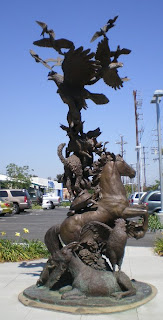 I recently visited the West Valley Animal Care Center on Plummer Street in Chatsworth. The city of Los Angeles no longer uses the term "Animal Shelter"; apparently it's too restrictive, or perhaps not euphemistic enough. This was the first time I had been there since the recent, major renovation, and I was pleasantly surprised. Unfortunately, this will sound as though I am damning it with faint praise: it is now the nicest animal shelter I've ever seen.
The whole place seems spacious and bright, with pleasant, helpful workers, and lots of friendly pets hoping for new homes. The restrooms are clean, and there are vending machines in the main hallway. Private rooms and play areas are available for prospective adopters to get acquainted with animals of interest.
Previously, the cats were kept in a small, stuffy room with a nasty smell. The number of cages has been significantly increased and they are now in a large, well-ventilated area. The day I visited, there were many empty cages, but one of the workers told me those will soon be occupied, as there are plenty of kittens waiting
 in the wings that are still a bit too young for public viewing. (I recommend adopting an adult cat. As experienced pets, they adapt well to household living, and are generally easier to care for and less destructive than kittens.) The cats looked clean and healthy, and most seemed interested in interacting with visitors.
The number of dog kennels has been increased from 56 to 152. One end of each kennel is outdoors (but covered) and, through a doggy door, the other end is in an air conditioned room, so the dogs can avoid overheating. Like the cats, the dogs looked clean and healthy. Although several of them seemed sad (who wouldn't be, under the circumstances?) the majority were alert and eager for human attention.
Additionally, the center houses rabbits, birds and exotics, which I did not visit.
To find out more about pet adoption and other services available from the Department of Animal Services, visit www.laanimalservices.com.
Reducing Water Use

On a recent weekend, I ripped out a flower bed and replaced it with this "rock garden". This enabled me to cap off one sprinkler head, and convert another to cover a smaller area. This is my first effort at rock gardening. I think it's too simple; while I was taking the picture it occurred to me that instead of just red lava rock, I could have made sections using two colors to make it more interesting.
In future posts I'll include photos of some of the interesting things my neighbors have done with rocks and succulents.
Vote Today
 Today is yet another special election in Los Angeles. On the ballot are six propositions relating to taxes and budgets, a runoff for city attorney, and community college district trustees. The polls will be open from 7:00am to 8:00pm. If you don't know where your polling place is, you can find it at http://www.lavote.net/.
Pepper Tree
 This California pepper tree (Schinus molle) is a volunteer in my garden. Less than two years old, it is already more than ten feet tall. Originally it had two main branches veeing away from the base, but one was damaged by winter storms and had to be cut away. The tree now has about half the volume it would otherwise have had.
I'm very fond of pepper trees, but I have mixed feelings about this one. It's not in a spot where a really large tree would be appropriate. Pepper trees are fast growers and can reach 30-40 feet high with a spread to match. Of, course, we can keep it under control (we think) with careful pruning.
Despite the name, these trees aren't really native to California. (Hint: They are also known as the Peruvian pepper tree.) They were brought here from South America by Spanish missionaries a few hundred years ago. They are now naturalized, although I have occasionally seen them classified as invasive, or even as weeds. Drought-resistant, they provide excellent shade, the Spaniards' motive for carrying them so far. Although apparently some people use the "peppers" (small pink fruits that grow in clusters in the fall) to flavor food, it's not a good idea, as they are toxic in quantity.
Trashy Neighbors
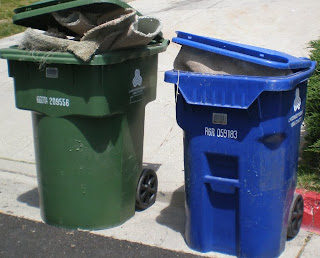 The green bins are for yard trimmings. The blue bins are for recyclable items. The black bins are for (non toxic) trash. This system has been in place for many years. So when our neighbors, Mr. and Mrs. Loud,* stuffed their green and blue bins full of old carpeting, they were the only ones to be surprised that the bins weren't emptied. "I didn't know," Mrs. L claimed later that morning. Luckily for her, the truck handling black bins had not yet arrived. So she waited by the bins, told the driver of the trash truck she had made a "mistake", and got him to empty these. It's a good thing, too, because the Louds' excess trash has a way of mysteriously appearing in other people's bins in the middle of the night.
*Not their real name, but an accurate description.
Arachnophobia?
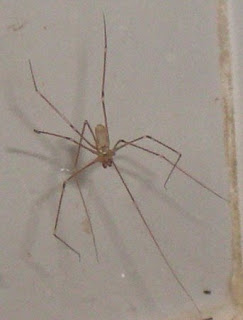 I photographed these daddy long-legs spiders (Pholcus phalangioides) in the women's restroom of the horticulture building at Pierce College. They seemed cozy, moving around their web in the narrow space between the side of the toilet and the wall. I photographed these daddy long-legs spiders (Pholcus phalangioides) in the women's restroom of the horticulture building at Pierce College. They seemed cozy, moving around their web in the narrow space between the side of the toilet and the wall.It's a good thing I'm not afraid of spiders, but this might explain why this restroom, unlike all the others on campus, seemed so clean. (Well, except for the part with the spiders.) No one dares use it. Apparently the Plant Facilities department has not yet issued brooms to this remote outpost. |
 Usually found in or around houses, the daddy long-legs is sometimes also called the cellar spider. (It is occasionally confused with a couple of other species that are also sometimes called long-legs or daddy long-legs.) They like to hang upside down from their webs and wait for prey. They eat small insects and spiders. When food is short, they will eat their own kind.
Gone But Not Forgotten
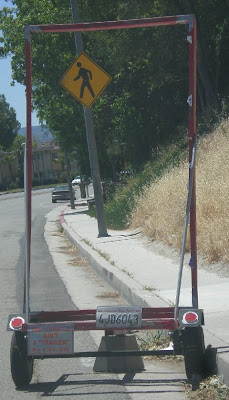 Last night someone informed me that the notorious political billboard had been removed. I photographed the trailer this morning.
I don't know who took the sign away, but it seems that it wasn't done in the usual way. Typically, these billboards stay parked in the same place for weeks or months at a time. Sometimes they are moved to a new location, and from time to time the billboards are replaced. I've never seen one of these trailers without a billboard.
I took this picture from my car. Note that if the billboard were still in place, it would be blocking my view of the pedestrian crossing sign. Also note the buildup of debris and trash around the tires.
Will we ever know who really paid for this, or who had it removed? Will there ever come a time when the city of Los Angeles enforces its regulations and takes action against these eyesores?
Alligator Lizard

We see a lot of lizards in this area. This is a southern alligator lizard (Elgaria multicarinata), a little over a foot long, relaxing in my driveway. Some individuals will grow to twice this length. These reptiles eat insects and snails, occasionally smaller lizards or bird eggs. If grabbed by a predator, the tail will break off easily, enabling the lizard to escape. (However, I have seen cats temporarily distracted by the tail who then went on to capture and eat the lizard.) The tail will regenerate to some extent, but the new tail will never have the length or beauty of its predecessor. This lucky little guy still has his original tail.

Subscribe to:
Posts (Atom)